Improvements
to Renuzit Mute
1. How to make it play in tune?
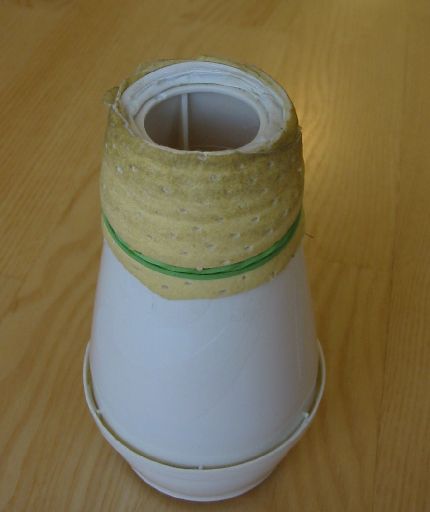
Although I'm a very beginner, I realized, that "the original renuzit
mute" plays badly out of tune. This was confirmed by my teacher, a
professional trumpet player. The mute raises the pitch of some notes, perharps due to
shortening the bell. To make it play in tune, I removed the "plug",
that closes the top of the container (on the side, that is pushed into
the horn):
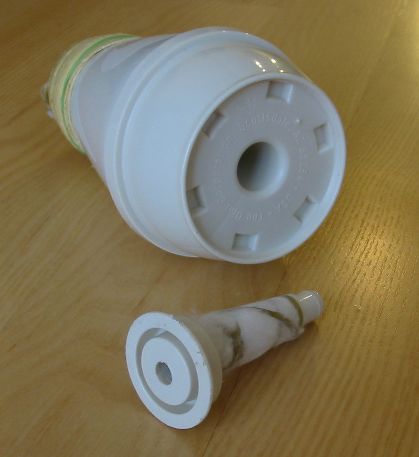
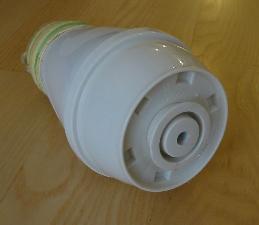
This makes the mute less efficient, so I wrapped the removed plug with
cotton, and pushed it into the hole on the other side:
This way the mute is about the same effective, but does not raise the
pitch so much, and plays almost perfectly in tune (this is my teacher's
opinion, I myself cannot play well in tune yet :)
2. How to build an amplifier for
headphones?
For those guys, who know a bit about electronics, it's quite simple to
build a small amplifier, which makes practicing with this mute more
funny. Instead of "plastic" buzz, you can hear something more like a
real trumpet sound, while not disturbing others with noise, and the
mute feels more "open" (no need to blow so hard to hear oneself).
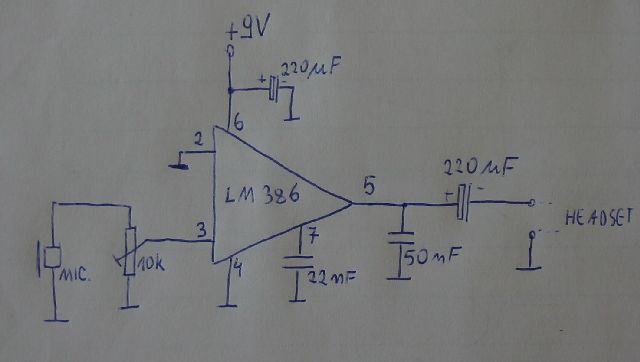
Here is the circuit I made, just the very basic audio amplifier (I used
LM386 because I had it handy in my drawer, perharps anything similar
would work the same):
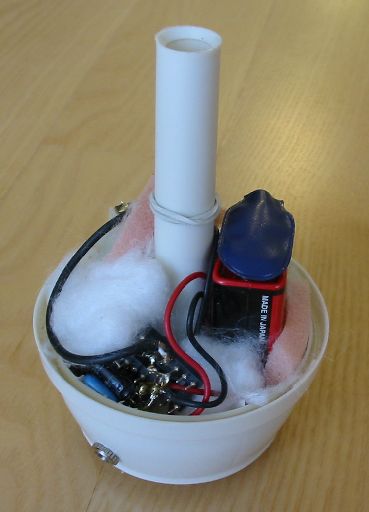
Here is how I put it inside the mute (just soldered those few
components together, without any circuit board):
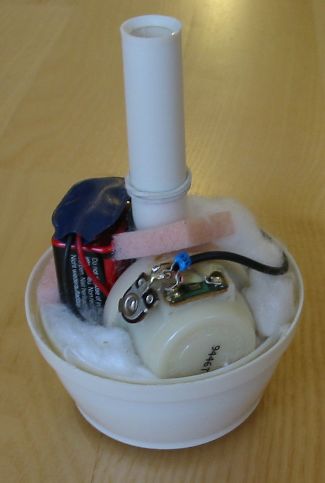
and the view on the microphone:
As for a microphone, I used a small speaker from a phone handset. I
mean the speaker part, not the
microphone. This thing works as a dynamic
microphone (any speaker does so). I chose this part after many
trials with various microphones, electret ones (all got overdriven by
the loud sound inside the mute), real dynamic microphones (also got
overdriven), and a small walkman-type headphones (poor sound, but I
tried poor headphones). From all the parts I had handy, this telephone
speaker yields the best sound output for this particular purpose, but
your results may vary.
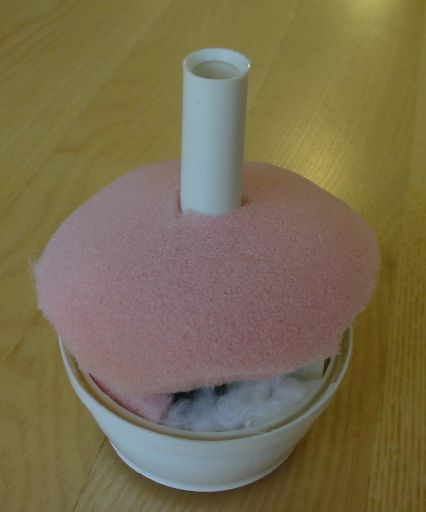
I also added some extra sound dampening stuff (cotton and foam):
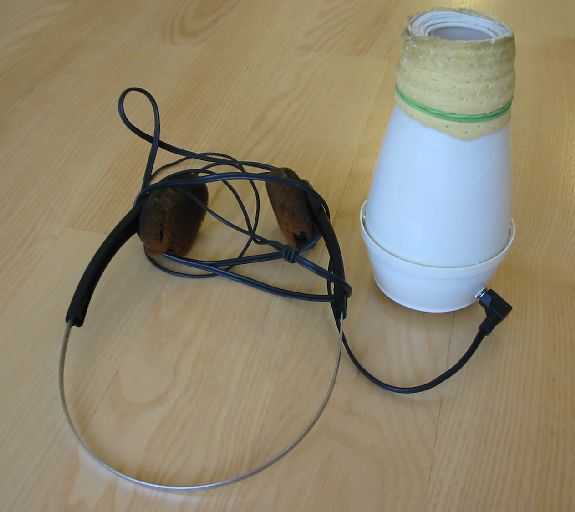
And the whole assembled stuff looks like this:
As you see, there is no power on/off switch, I used a headphone socket
with internal switch. There is no external volume control, I realized
that I don't need it, the trumpet itself doesn't have any volume
control either, and nobody complains about that :)
The mute with all this stuff inside is a bit heavy, but doesn't fall
off the bell. The dirty yellow wrap, that makes the seal, is a piece of
the special cloth for cleaning home or car windows. Works well, also
absorbs the moisture
from the bell. Don't make any waterproof seal (rubber, closed cell
foam, or something similar), as the bell will collect lots of water
during playing, and rubber will leave dark spots on the silver plated
bell (at least did on mine).
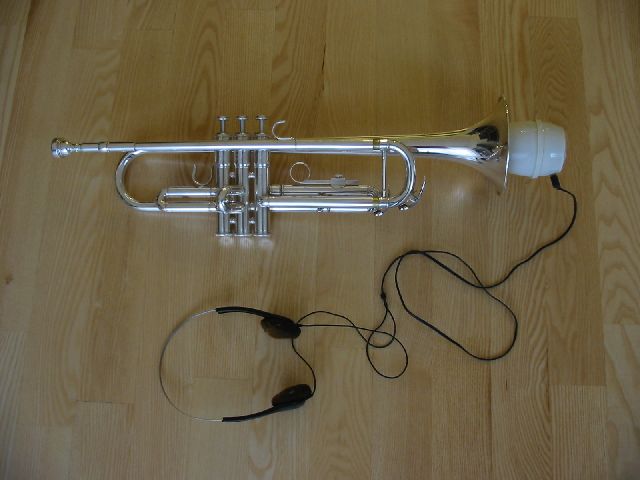
Here is the whole thing with my trumpet:
Doesn't look fancy, but works for me. When I find some time to make a
proper cable, I'll try to provide here a sample of sound, that I hear
in the headset. The sound is quite acceptable in my opinion, at least
for practicing. The headset is very important, and it doesn't mean that
expensive ones will be the best here. I found that ones from an old
Philips walkman work best for me, although generally for listening to
the music they are rather crappy. Just check what works for you.
Thanks for William for sending me two pieces of Renuzit, which is not
available in my area.
If you have any questions: pawelp@freeland.lublin.pl
Back